Aurora's subgrade tells a story of glacial Lake Chicago. The silty clay deposits beneath much of the city can lose half their bearing capacity when saturated in spring. That matters for rigid pavement design because a concrete slab doesn't flex—it bridges soft spots until it cracks. Our team has worked on industrial parks near the Fox River where the water table sits just four feet below grade, and we’ve seen how quickly an under-designed pavement joint deteriorates under freeze-thaw cycles. Before a single cubic yard of concrete is poured, we correlate plasticity indices from atterberg limits with the PCA thickness selection tables. For heavily loaded intersections like those near the Chicago Premium Outlets, we also pull CBR road test data to validate the foundation stiffness assumptions, ensuring the pavement endures 20-plus years of truck traffic without uncontrolled cracking.
A rigid pavement in Aurora is not a slab—it's a structural plate bridging variable subgrade, and the joint system makes or breaks the entire investment.
Technical details of the service in Aurora
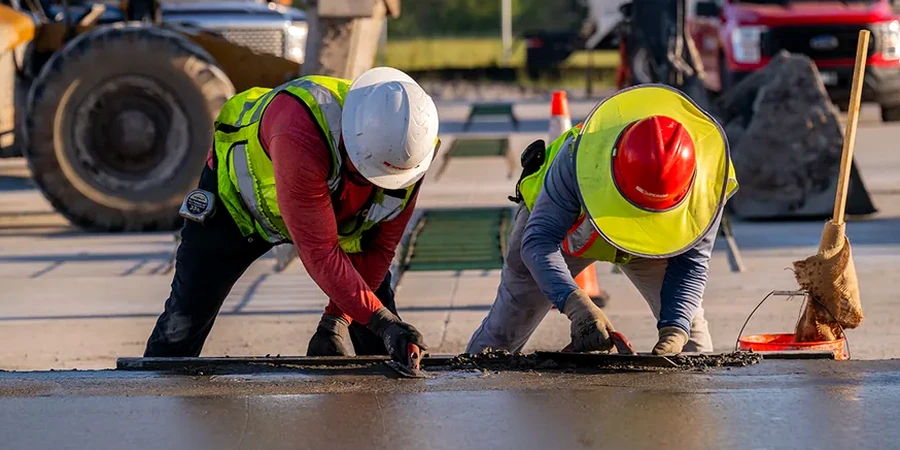
Local geotechnical conditions in Aurora
What we notice in Aurora’s older industrial corridors, particularly east of the river where the fill is deeper, is that pavement failures rarely start in the concrete. They start in the base. Silt migration from the subgrade clogs the open-graded drainage layer, and trapped water saturates the aggregate. Under repeated axle loads, pumping action ejects fines through the joints, creating voids beneath the slab corners. A corner break is just a matter of time. Another risk is alkali-silica reaction (ASR) in the aggregate—some local gravel sources from the Fox River valley are moderately reactive. We specify supplementary cementitious materials, usually Class F fly ash at 20–25% replacement, to mitigate expansion. Skipping this step has led to map-cracking in pavements less than seven years old. The cost of a petrographic analysis before mix design approval is trivial compared to a full-depth reconstruction.
Our services
We provide rigid pavement design as a focused geotechnical-structural interface service. This is not a generic civil plan—it’s a thickness and jointing solution calibrated to Aurora’s subgrade variability and climate loading.
Industrial and Warehouse Pavement Design
Design for heavy forklift traffic, trailer staging areas, and container yards. We use PCA slab-on-grade methods with k-value back-calculation from field CBR or plate load tests. Joint layout optimized for material handling equipment wheel paths.
Municipal and Intersection Pavement Design
Rigid pavement design for Aurora’s arterial roads and signalized intersections. We incorporate tied concrete shoulders, doweled contraction joints, and high-early-strength mix designs for overnight construction windows per IDOT specifications.
Quick answers
What is the typical design life of a rigid pavement in Aurora’s climate?
We typically design for a 30-year service life for municipal and industrial rigid pavements in Aurora. The AASHTO 1993 method uses a reliability factor (R=85–95% depending on functional classification) that accounts for the freeze-thaw cycles and subgrade variability common in the Fox River Valley. Achieving that life requires proper joint sealing maintenance and avoiding de-icing salts that accelerate dowel bar corrosion.
How much does rigid pavement design and testing cost for a typical Aurora project?
Do you recommend doweled or undoweled joints for Aurora pavements?
We strongly recommend doweled joints for any rigid pavement in Aurora that will carry trucks or buses. Undoweled joints rely on aggregate interlock for load transfer, and our local silty clay subgrades lose support rapidly once water enters the joint. Dowels (smooth round bars, ASTM A615) maintain vertical alignment across the joint and prevent faulting, which is the most common distress we see in undoweled pavements after five to seven years in this region.