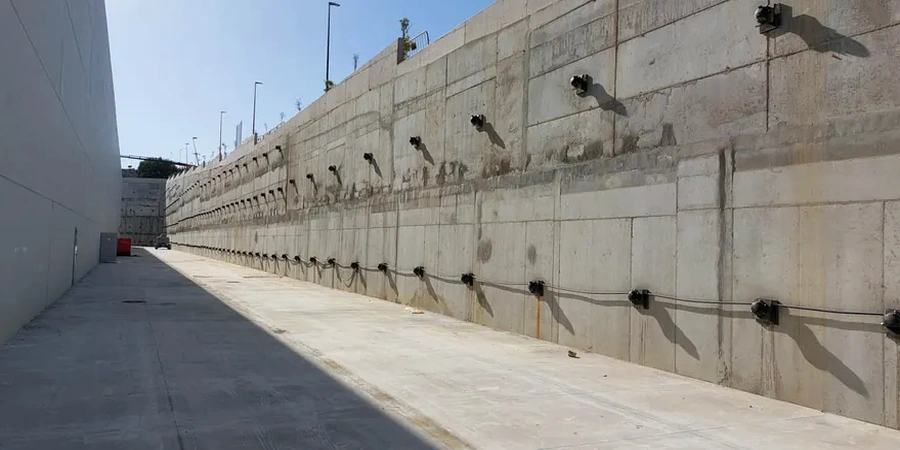
Aurora's growth along the Fox River left a legacy of complex subsurface conditions. The city's downtown developed on river terraces with interbedded sand and clay strata. These deposits demand precise lateral support systems. Our team designs active and passive anchors that account for the local stratigraphy. The 1996 downtown revitalization exposed just how variable the soil can be within a single block. We combine data from SPT drilling with laboratory shear strength tests to calibrate bond zone capacity in these interbedded deposits.
A properly tensioned anchor transfers load beyond the Rankine failure plane into competent soil, not just by friction but by mechanical interlock with the grout column.
Technical details of the service in Aurora
Demonstration video
Local geotechnical conditions in Aurora
The west side near the river channel has up to 40 feet of compressible alluvium; the east side sits on dense Wisconsinan till. A tieback designed for the till's high cohesion will creep excessively if installed in the soft silty clay of the floodplain. We've seen ungrouted passive anchors pull out at 60 percent of design load in these conditions. The water table fluctuates seasonally by 8 to 12 feet. This cyclic saturation reduces effective stress in the bond zone. Our designs always run post-grouting sensitivity checks. For permanent riverfront walls, a sacrificial steel allowance of 1.5 mm per 75 years is the minimum we specify given the local groundwater pH.
Our services
Anchor design for Aurora projects typically falls into four categories, each addressing a specific lateral earth pressure scenario.
Active Anchors for Cut Walls
High-strength strand tendons tensioned to 70 percent of GUTS. Used in soldier pile and lagging walls along the Fox River corridor.
Passive Tieback Systems
Grouted bars that mobilize resistance only when the wall deflects. Ideal for temporary excavation support in the dense till on Aurora's east side.
Performance Proof Testing
On-site verification per ASTM D3966. We log creep displacement at 1, 2, 3, 5, 6, 10, 15, 20, 25, 30, 45, and 60 minutes.
Lift-Off and Monitoring
Post-installation residual load checks using calibrated hydraulic jacks. Critical for Aurora projects near vibration-sensitive historic structures.
Quick answers
What is the difference between active and passive anchors?
Active anchors are tensioned against the structure immediately after grout reaches strength. They apply a known preload to the soil mass. Passive anchors are not tensioned. They only develop resistance when the retained soil begins to move. We specify active anchors for permanent walls with strict deflection limits, and passive anchors for temporary support in competent glacial till where small movements are tolerable.
How deep do anchors need to be in Fox River Valley soils?
The unbonded length must extend at least 5 feet beyond the theoretical Rankine or log-spiral failure surface. In Aurora's downtown, that often means 20 to 30 feet of unbonded length before the 15- to 25-foot bond zone begins. The bond zone must be in competent material. If the zone falls in soft alluvium, we extend it until it seats in dense till or bedrock.