Aurora's industrial roots run deep into the Fox River Valley. The old rail yards and the quarry districts left behind a patchwork of fill materials that can't be verified by visual classification alone. Our lab handles sieve analysis and hydrometer testing to ASTM D422 standards because these mixed glacial deposits demand it. A building pad off Farnsworth Avenue might look like clean sand but carry 18 percent fines from reworked lacustrine silt. Miss that and the drainage design fails. We combine the full sieve + hydrometer protocol with Atterberg limits when the silt fraction exceeds 12 percent. This gives Aurora's geotechnical engineers the numbers they need for frost heave susceptibility and compaction specifications without waiting a week for results.
A D10 of 0.002 mm changes everything. The full curve from Sieve No. 4 to the 0.001 mm range separates competent fill from frost-susceptible silt. Guessing is not an option.
Technical details of the service in Aurora
Demonstration video
Local geotechnical conditions in Aurora
Aurora's weather swings from sub-zero winters to saturated spring thaws. The silt-rich deposits common along the Fox River corridor are highly frost-susceptible. A grain size curve with more than 10 percent passing the 0.02 mm sieve signals real trouble for shallow footings. Ice lens formation in these silts generates heave pressures that crack slab-on-grade construction by February. The hydrometer data becomes the deciding factor. We've seen projects near Phillips Park where the fines content looked marginal in the field but the lab hydrometer showed a clay fraction of 8 percent. That small percentage altered the Unified Soil Classification from SM to SC, triggering a different bearing capacity factor entirely. If the D10 falls below 0.005 mm, the material is practically impermeable. Drainage design changes instantly. Aurora's older neighborhoods carry undocumented fill layers from the 1950s building boom. Performing a test pit investigation and linking the field log to the lab gradation curve is the only way to map these buried risks.
Our services
Our Aurora lab processes hundreds of gradation samples each month. The work splits into two clear technical paths based on the dominant particle size. Both use calibrated sieves and ASTM 152H hydrometers with temperature correction applied to every reading.
Mechanical Sieve Analysis (Coarse Fraction)
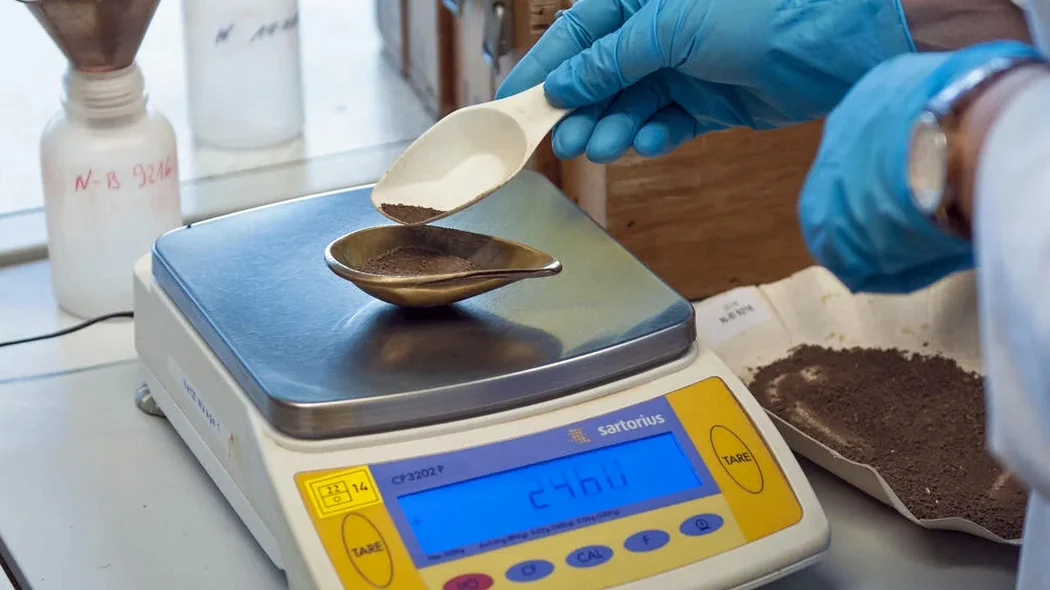
Sieve stack from 3 inches down to No. 200. We use a Ro-Tap shaker for consistent agitation time. Each fraction is weighed to 0.1 g with a calibrated balance. The percent retained is calculated against the total dry mass. We report the gradation curve, Cu, Cc, and the Unified Soil Classification symbol. Suitable for sands and gravels with less than 5 percent fines by weight.
Hydrometer Analysis (Fine Fraction)
Sedimentation test per ASTM D7928. A 50 g sample of minus No. 200 material is dispersed in a sodium hexametaphosphate solution. Hydrometer readings are taken at 1, 2, 5, 15, 30, 60, 250, and 1440 minutes. The temperature-corrected readings are converted to percent finer by Stokes' Law. We produce the complete grain size distribution curve from 0.075 mm to 0.001 mm. Required for Aurora silts and clays where the hydrometer controls the classification.
Quick answers
What does a sieve and hydrometer analysis cost in Aurora?
A complete combined grain size analysis (sieve through No. 200 The price depends on the number of samples and whether you need just the gradation curve or the full USCS classification with Atterberg limits included. We can typically deliver the report within 24 to 48 hours for standard workloads.
When is a hydrometer test required instead of just a sieve analysis?
A hydrometer test is required when more than 12 percent of the sample passes the No. 200 sieve. The sieve analysis alone cannot determine the silt versus clay fraction. The hydrometer sedimentation data gives the D10, D30, and D60 for the fine fraction. This is essential for USCS classification of fine-grained Aurora soils and for assessing frost susceptibility under IBC requirements.
How do you handle samples with gravel particles larger than 3 inches?
We follow the ASTM D422 procedure for oversized particles. The plus-3-inch fraction is sieved separately in the field or lab using larger mesh sizes. The gradation curve is then computed using a composite correction factor based on the percent oversize by mass. The final report includes the full curve with the corrected percent passing for all sieve sizes including the coarse rock fraction.