The most expensive mistake in Aurora is assuming the Fox River floodplain deposits are stable under seismic load. They are not. Loose, saturated sands and silts dominate the valley floor, and a distant New Madrid or local Wabash Valley event can trigger liquefaction at depths that compromise foundations designed only for static conditions. We see this gap in older commercial buildings near downtown, where pre-1990 borings ignored cyclic mobility entirely. Our soil liquefaction analysis combines SPT field data with lab-based fines content and plasticity index screening. The result is a factor of safety against liquefaction — not a guess, not a generic hazard map. When site stratigraphy demands higher resolution, we pair the assessment with CPT testing for continuous tip resistance and sleeve friction profiles, eliminating the recovery gaps that can hide thin, critical loose layers.
A factor of safety below 1.3 in the Fox Valley alluvium means post-liquefaction settlement can exceed 4 inches. That is a structural problem, not a footnote.
Technical details of the service in Aurora
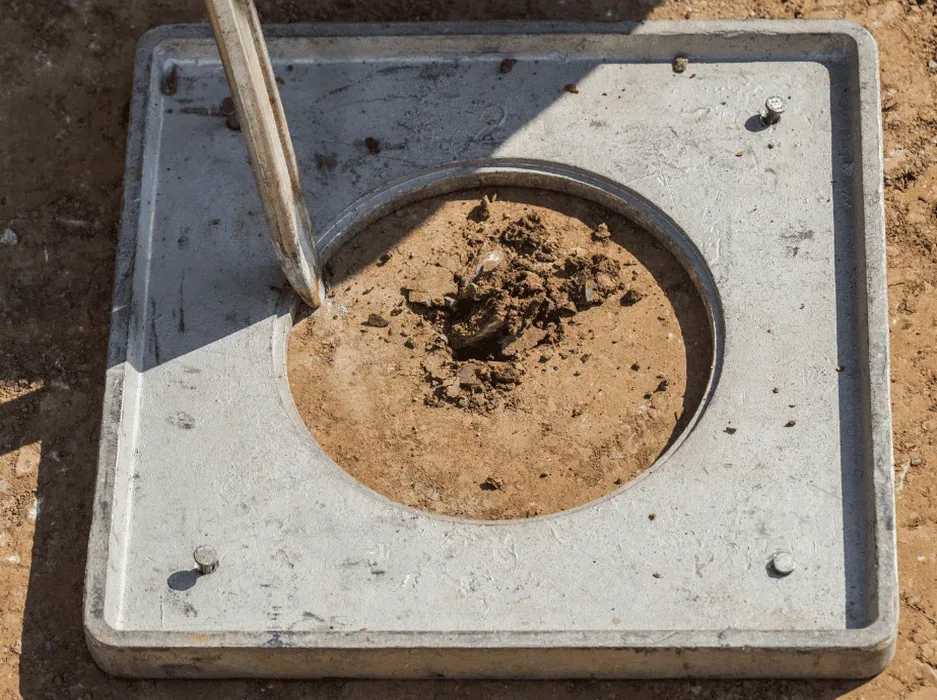
Local geotechnical conditions in Aurora
Aurora sits 676 feet above sea level, but the seismic risk comes from below. The Wabash Valley seismic zone produced a 5.4 magnitude event in 2008, and paleoliquefaction features in the Midwest confirm that New Madrid-style events have reached Illinois in the past. Loose saturated sands at 10-30 feet depth are the primary concern. Liquefaction does not just mean sudden bearing failure — it means 2 to 6 inches of differential settlement across a building footprint, ruptured utilities at the street connection, and lateral spreading toward any open cut or riverbank. The IBC requires site-specific liquefaction assessment for Seismic Design Category D and above, which covers most essential facilities in Kane County. A desktop denial based on regional maps does not satisfy the building official, and it should not satisfy the structural engineer.
Our services
Our soil liquefaction analysis services cover the full workflow from field investigation to final report. We do not subcontract the lab work — it runs through our ASTM-compliant soil mechanics laboratory, which maintains AASHTO accreditation for SPT calibration and grain size testing.
SPT-Based Liquefaction Triggering Analysis
We perform corrected N-value profiling, fines content screening, and cyclic stress ratio calculation per the NCEER simplified procedure. Deliverables include factor of safety versus depth plots and post-liquefaction volumetric strain estimates for settlement analysis.
Laboratory Index Testing for Liquefaction Screening
Grain size distribution by sieve and hydrometer, Atterberg limits, and natural moisture content. These parameters determine whether a soil is susceptible to liquefaction or behaves as a non-liquefiable cohesive material under the Boulanger-Idriss criteria.
Quick answers
What depth range does a standard liquefaction analysis cover in Aurora?
We typically assess from the ground surface to 60 feet, which covers the Fox River alluvium and the upper portion of the underlying glacial till. Depths beyond 60 feet can be included when deep foundations or basement levels extend into potentially liquefiable units.
How much does a soil liquefaction analysis cost for a commercial site?
Does the IBC require liquefaction analysis for every project in Aurora?
Not every project, but it is mandatory for structures assigned to Seismic Design Category D, E, or F. In Aurora, essential facilities, tall buildings, and sites with known loose saturated sands typically fall into these categories. The building official may also require it for any site where subsurface conditions suggest susceptibility.
What is the difference between a screening-level and a detailed liquefaction analysis?
Screening uses published surficial geology maps and regional groundwater data to flag potential risk. A detailed analysis uses site-specific SPT or CPT data, measured groundwater, and lab-tested fines content to compute a numerical factor of safety at each depth. Only the detailed approach satisfies ASCE 7 for design.