Watching a crew run a sheepsfoot roller over the stiff, silty clay off Eola Road last fall, the foreman asked why the density still wasn't hitting spec. The lab had been running a Modified Proctor on what turned out to be a lean clay with sand lenses—typical of the glacial till that underlies much of Aurora’s west side. We pulled a bucket sample from the same lift, ran a Standard Proctor alongside it, and the optimum moisture curve shifted almost three percent. That difference meant adjusting the water truck, not the compactor. In our experience across Kane and DuPage counties, the Proctor test is the single most misunderstood piece of the compaction puzzle—everyone wants the number, but few take the time to match the compactive effort to the actual field equipment. When we see a site near the Fox River, where groundwater sits shallow and silts dominate, we often pair the Proctor with a grain size analysis to confirm fines content before selecting the right procedure.
The peak of the Proctor curve is a target, not an absolute—understanding the wet-side behavior of Aurora's glacial clays prevents over-compaction failures in the field.
Technical details of the service in Aurora
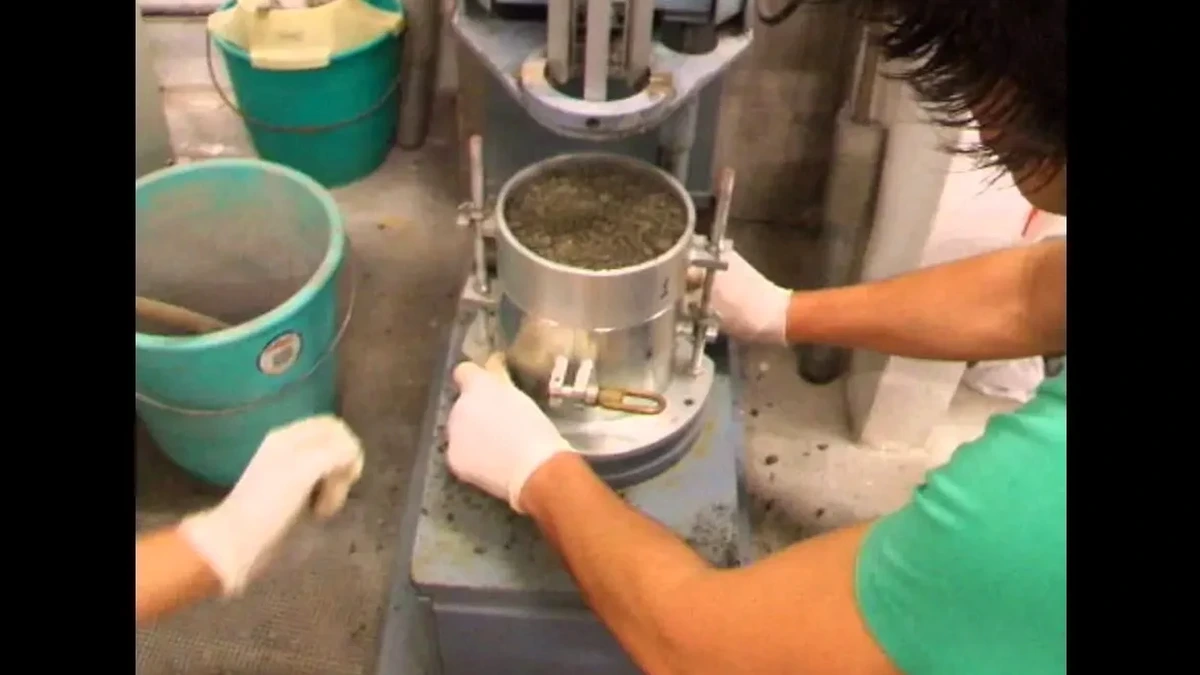
Local geotechnical conditions in Aurora
Aurora sits on a complex glacial stratigraphy: the Yorkville Member of the Wedron Group—predominantly silty clay with intermittent sand and gravel lenses—blankets much of the city, with the Fox River having carved through it and deposited alluvium in the downtown corridor. This geology creates two distinct compaction risks. First, the natural moisture content of the Yorkville clay often sits above optimum during spring and fall, forcing contractors to either wait for dry weather or mechanically stabilize the subgrade. Second, the sand lenses that appear unpredictably in the till can fool a density gauge: a sand-cone test may read passing density while the underlying clay is still soft. We learned this the hard way on a warehouse project near Orchard Road where post-construction settlements appeared within six months—the Proctor had been run on a composite sample that masked the clay fraction. Today we require separate Proctor curves for each distinct soil type encountered on a site. IDOT and the Aurora building department both reference ASTM D698 and D1557 in their earthwork specifications, and failing to submit the correct curve can stop a project dead during proof-rolling.
Our services
We run Proctor tests as standalone lab work or as part of a broader earthwork quality control package. Every project gets a clear recommendation on which method applies and why.
Standard and Modified Proctor Testing
ASTM D698 and D1557 lab compaction tests with full moisture-density curves. We report optimum moisture content, maximum dry density, and wet-side curve interpretation. Turnaround is typically 48 hours for single-point correlations.
Field Density Correlation
We pair lab Proctor results with nuclear gauge or sand-cone field density testing to report percent compaction against the correct standard. This closes the loop between lab optimum and field performance on Aurora earthwork projects.
Quick answers
How much does a Proctor test cost in Aurora, IL?
Which Proctor method should I use for a residential foundation in Aurora?
For single-family and low-rise residential foundations on the silty clays common in Aurora, ASTM D698 (Standard Proctor) is almost always the correct specification. Using the Modified Proctor on a residential subgrade sets an unrealistic density target that standard compaction equipment cannot achieve, leading to unnecessary rework and delays.
How long does a Proctor test take to complete?
A single Proctor curve with five moisture points requires approximately 4-6 hours of lab time, including sample drying, pulverizing, sieving, compaction, and oven-drying moisture tins. We provide results within 48 hours of sample receipt for routine projects; same-day turnaround is available by prior arrangement for time-sensitive earthwork.
What soil types in Aurora are problematic for Proctor testing?
The glacial Yorkville silty clay that covers much of Aurora presents challenges because its natural moisture content is frequently above optimum, especially in spring and fall. We also encounter sand and gravel lenses in the till that require separate Proctor curves. Running a single composite Proctor on layered material is the most common mistake we see—it masks the true compaction behavior of the finer fraction.