Aurora’s landscape conceals a subsurface reality that directly governs retaining wall performance. Beneath the topsoil, the city rests on Wisconsinan glacial till — a mix of silty clay and discontinuous sand lenses that can hold perched groundwater well into spring. In older sections near the Fox River, you encounter alluvial deposits with low bearing capacity, while upland subdivisions east of Route 59 sit on compacted ice-margin diamicton. Our team has worked across these transitions and understands that a retaining wall in Aurora succeeds or fails on the drainage detail, not just the stem design. The city’s Engineering Division requires submittals consistent with IBC Chapter 18, and we routinely pair our designs with a test pit investigation in Aurora to confirm stratigraphy at the wall alignment before finalizing reinforcement lengths.
A retaining wall in Aurora’s Fox River Valley clay needs drainage capacity for the March thaw, not just the design storm.
Technical details of the service in Aurora
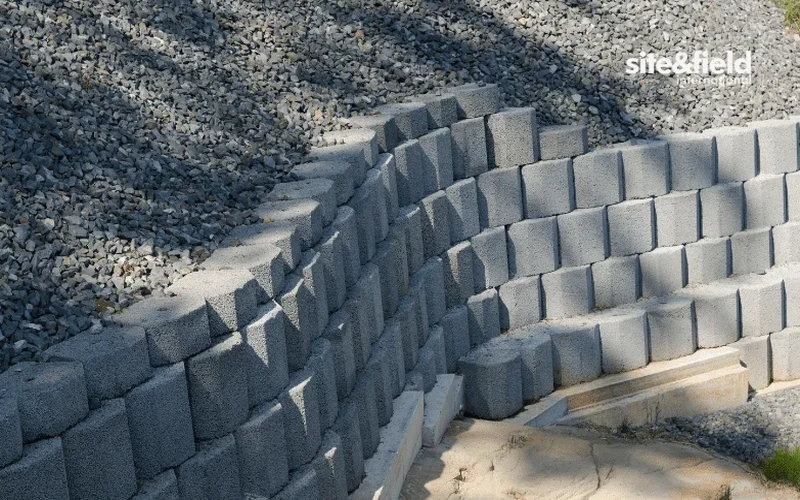
Local geotechnical conditions in Aurora
A Cat 330 excavator working in Aurora’s silty clay can open a wall trench in two shifts, but that speed invites shortcuts. The biggest hazard we see is a contractor backfilling with site-generated clay because importing stone adds a day. Clay backfill against a rigid wall builds pore pressure with every freeze-thaw cycle — we have measured 18-inch outward displacements on a four-year-old wall near Waubonsie Creek that had no heel drain. Our construction observation package includes a fill verification hold point: the inspector checks the backfill gradation against the project specification before the first lift goes in. On walls with tiered reinforcement, we also require a proof roll of the subgrade with a loaded dump truck to catch soft spots that would rotate the leveling pad.
Our services
Our retaining wall design package in Aurora covers everything from the initial subsurface exploration to the signed and sealed submission set. We handle the geotechnical baseline, the structural sizing, and the global stability verification under one scope.
Cantilever & Gravity Wall Design Package
Complete structural-geotechnical design for cast-in-place and segmental block walls up to 12 feet exposed height. Includes bearing capacity checks on Aurora glacial till, sliding and overturning stability per IBC 1807.2.3, stem and footing reinforcement schedules, and a construction-phase drainage detail sheet.
MSE Wall & Global Stability Analysis
Mechanically stabilized earth design with geogrid or welded-wire reinforcement for walls above 10 feet or where right-of-way geometry forces a steep reinforced zone. We run Spencer limit equilibrium on cross-sections parallel and oblique to the wall face, checking both the reinforced block and the overall embankment to meet a minimum factor of safety of 1.5 static.
Frequently asked questions
What triggers a permit for a retaining wall in Aurora, and do I need stamped calculations?
The City of Aurora Building & Permits Division generally requires a permit for any retaining wall over four feet in height measured from the bottom of the footing to the top of the wall, or for any wall supporting a surcharge such as a driveway or adjacent foundation. Stamped calculations and construction drawings signed by an Illinois-licensed structural or geotechnical engineer are part of the submittal package. We coordinate directly with the city’s plan reviewer and have successfully permitted walls in the Downtown Aurora TIF district, the Fox Valley Mall corridor, and multiple residential subdivisions east of Eola Road.
How much does a retaining wall design cost for a residential lot in Aurora?
For a typical single-family residential retaining wall in Aurora — say a 5- to 8-foot cantilever wall with a straight alignment under 60 linear feet — our design fee ranges from US$920 to US$3,940 depending on whether new subsurface exploration is required, the complexity of the drainage solution, and the number of global stability cross-sections the city requests. If we can reuse existing geotechnical data from a prior investigation on the lot, the cost usually falls toward the lower end. Commercial and subdivision-scale MSE walls with multiple tiers and roadway surcharge loading run higher because of the additional analysis and drawing production.
What soil condition in Aurora causes the most retaining wall problems?
The biggest trouble comes from discontinuous sand lenses within the Wadsworth Till that act as perched aquifers during spring snowmelt. When a wall excavation cuts through one of these lenses, water flows into the backfill zone and can saturate the retained soil mass within hours. Without a properly graded drainage composite and a functional outlet, hydrostatic pressure builds against the stem. We routinely specify a continuous strip drain wrapped in non-woven geotextile and a 6-inch collector pipe graded to daylight or a sump pump chamber to intercept this perched flow before it becomes a structural load.