A recent microtunneling project beneath a 1930s-era brick sewer interceptor near downtown Aurora encountered 14 feet of lacustrine clay with undrained shear strengths dipping below 800 psf at tunnel invert—conditions that would overwhelm a standard EPB machine without preconditioning. The Fox River Valley left Aurora draped in up to 60 feet of Wadsworth Till overlying Silurian dolomite, but the real challenge sits in the post-glacial lake deposits: laminated silty clays that remold into slurry under excess pore pressure. Our laboratory ran consolidated-undrained triaxial tests on Shelby tube samples extracted from five boreholes spaced along the alignment, then paired those results with CPT pore pressure dissipation tests to map the hydraulic boundary between the peat lenses on the east bank and the stiff desiccated crust near the west terrace. For TBM launch pit design we integrated the undrained shear strength profile with a slope stability back-analysis that accounted for drawdown during dewatering, because the Illinois State Water Survey well logs show a seasonal artesian response in the lower sand unit that can push uplift pressures past 60% of overburden within 48 hours of a barometric drop.
Tunneling through Aurora's post-glacial lacustrine clays demands undrained shear strength profiles at 2-foot vertical resolution—averaging across 10-foot intervals will mask the thin silt laminae that govern face stability.
Technical details of the service in Aurora
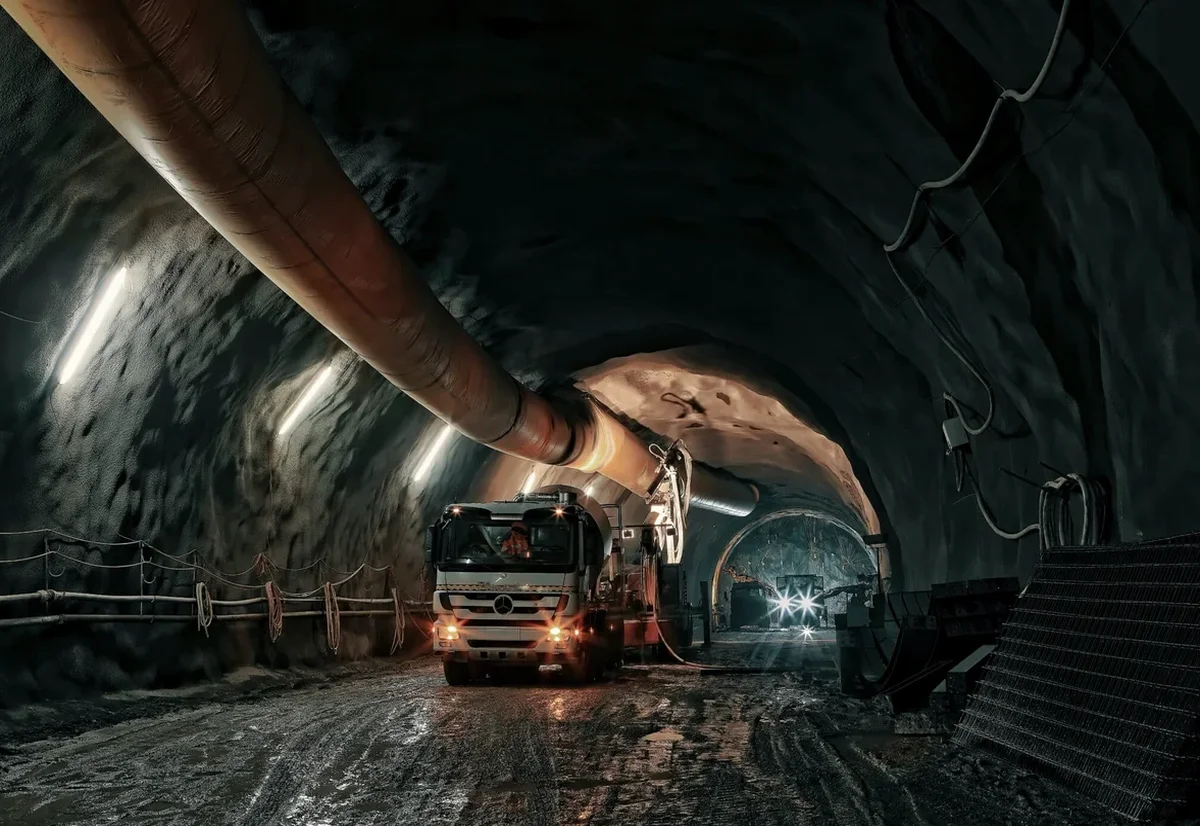
Local geotechnical conditions in Aurora
Aurora's continental climate imposes a freeze-thaw front that penetrates 36 inches below grade by mid-February, yet the tunnel alignment typically sits at 18 to 35 feet depth where ground temperatures hold steady near 52°F year-round—this thermal stability masks the real hazard: the January-to-March groundwater recharge cycle raises the potentiometric surface in the basal sand unit enough to reverse vertical hydraulic gradients and push artesian pressures against the tunnel lining. Spring snowmelt combined with Fox River stage increases of 4 to 6 feet will saturate the upper silt seams within 72 hours, dropping effective stress at the face and triggering localized blow-in failures in open-face shields. Differential consolidation settlement between the tunnel structure and adjacent 100-year-old brick-arch sewers—some of which sit on timber pile foundations in the organic silt lenses near the river—can exceed 1.5 inches over a 20-year design life if the long-term creep behavior of the plastic clays is not modeled using isotache-based settlement predictions rather than conventional Terzaghi one-dimensional theory.
Our services
Soft-ground tunnel projects in the Fox River Valley require a phased geotechnical approach that moves from regional stratigraphic mapping down to element-scale soil-structure interaction. The following service packages reflect the investigation intensity needed when tunneling through compressible glacial deposits with high groundwater.
Tunnel Alignment Geotechnical Baseline Investigation
Borehole program spaced at 150-foot centers along the alignment with continuous SPT sampling, Shelby tube recovery in cohesive units, and piezometer nests at three depths to map the multi-aquifer system. Laboratory deliverables include CIU triaxial compression, one-dimensional consolidation with time-deformation curves, Atterberg limits, grain size distribution by hydrometer, and pore water chemistry for TBM conditioner compatibility. We deliver a GBR-compatible data report organized by chainage station with interpreted engineering parameters ready for design-build procurement.
Face Stability and Settlement Analysis Package
Finite-element and limit-equilibrium modeling of tunnel face support pressure requirements under undrained and partially drained conditions. We calibrate the constitutive model parameters against site-specific triaxial stress paths, run parametric studies on excavation rate versus pore pressure dissipation, and compute transverse settlement troughs using both empirical Gaussian curve methods and coupled consolidation analysis. Outputs include maximum allowable volume loss targets and instrumentation trigger levels for settlement monitoring adjacent to Aurora's historic infrastructure corridors.
Quick answers
What is the typical cost range for a soft-ground tunnel geotechnical investigation in Aurora?
Which laboratory tests are most critical for tunnel design in Aurora's lacustrine clays?
Consolidated-undrained triaxial compression tests (ASTM D4767) with pore pressure measurement provide the undrained shear strength envelope needed for face stability calculations. One-dimensional consolidation tests (ASTM D2435) at the correct load-increment ratios capture the compressibility contrast between the desiccated crust and the normally consolidated zone at tunnel depth. Resonant column tests supply the small-strain stiffness degradation curves that PLAXIS and FLAC3D require for realistic deformation predictions. Atterberg limits and liquidity indices help identify the sensitive, remoldable clay seams that can fluidize under shield advance.
How does the high groundwater in the Fox River Valley affect tunnel excavation methods?
The piezometric surface in the St. Charles aquifer sits 8 to 15 feet above typical tunnel crown elevations in central Aurora, which means open-face excavation methods are rarely viable without extensive dewatering—and dewatering carries its own settlement risk to adjacent structures on shallow foundations. Closed-face shields (EPB or slurry TBMs) are preferred, but face support pressure must be tuned to the undrained shear strength profile because over-pressuring in the sensitive laminated clays can generate surface heave of 0.5 to 1.0 inches. We recommend pore pressure dissipation testing during CPT soundings to calibrate the hydraulic conductivity assumptions used in face pressure calculations.