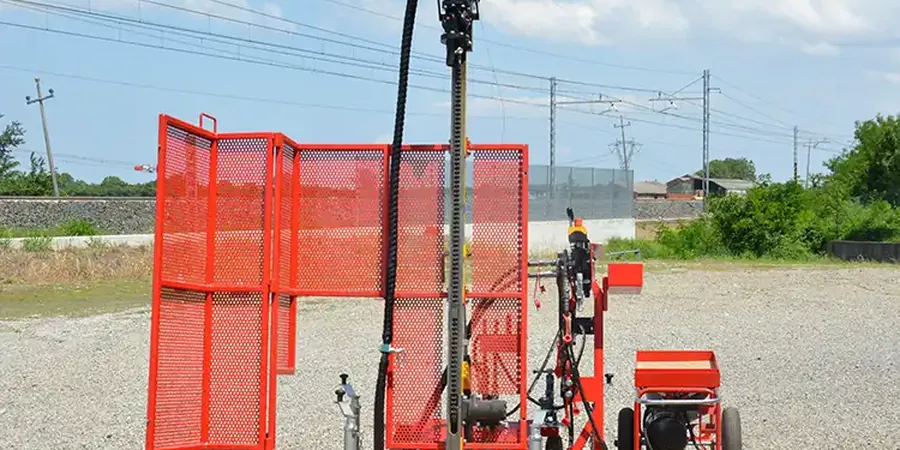
When drilling through Aurora's glacial till and outwash deposits, the resistance we feel at the split-spoon sampler tells us more than just a number—it reveals where the weak lenses of silt and soft clay hide beneath the surface. The Fox River left a complex stratigraphy across the city, with layers of sand, gravel, and compressible silts interbedded in ways that no desktop study can predict. Our team runs the Standard Penetration Test at sites from the historic districts near downtown to new subdivisions on the west side, always following ASTM D1586-18 procedures with a calibrated automatic hammer. Because Aurora sits in a region where the seismic hazard, though moderate, still requires a Site Class determination per ASCE 7-22 Chapter 20, we correlate N-values with shear wave velocity estimates and integrate the results with a MASW survey when the project demands a more refined Vs30 profile. That dual approach, combining direct penetration resistance with geophysical data, gives structural engineers the confidence to select the right foundation system without overconservative assumptions that inflate costs. In a city with over 180,000 residents and growing, getting the subsurface characterization right on the first mobilization avoids expensive change orders later.
An SPT N-value alone is just a number—but correlated with local geology and lab index tests, it becomes the backbone of a defensible bearing capacity recommendation.
Technical details of the service in Aurora
Demonstration video
Local geotechnical conditions in Aurora
Aurora sits on a sequence of Quaternary glacial deposits—the Wedron Group tills and the Henry Formation outwash sands and gravels—that vary drastically in thickness and density over short distances. The Fox River and its tributaries have reworked these deposits, leaving buried channels filled with soft organic silt and loose sand that can produce SPT N-values below 4 for several feet of depth. Missing those pockets means designing footings on a false assumption of competent bearing, which in Aurora's freeze-thaw climate leads to differential settlement and cracked foundations within the first five winters. The IBC 2021 classifies much of Kane County as Seismic Design Category B, but the potential for a magnitude 5.5 event on the Sandwich Fault Zone, though low-probability, means that Site Class E or F profiles—those with soft clay layers identified only by SPT—trigger higher seismic coefficients in the structural analysis. If the driller stops the boring too early, before penetrating through the compressible layer into dense till, the entire foundation recommendation becomes unreliable. We core through the suspect strata until refusal or until the N-value consistently exceeds 30 blows per foot, confirming that the load-bearing stratum is competent and continuous across the footprint.
Our services
Our SPT investigation in Aurora goes beyond counting blows. We deliver a complete geotechnical data package that supports foundation design, seismic site classification, and earthwork specifications.
SPT Borehole Logging and N60 Reporting
Complete borehole drilling with SPT sampling at 5-foot intervals, groundwater monitoring, and field classification. We deliver corrected N60 values, soil descriptions per ASTM D2487, and a boring log with stratigraphic columns ready for the geotechnical report.
Liquefaction Screening and Seismic Site Class
Evaluation of liquefaction potential using SPT-based NCEER methodology with fines content correction from laboratory grain-size tests. We classify the site per ASCE 7-22 Table 20.3-1 and provide the seismic parameters required by the structural engineer for the Aurora building permit submission.
Quick answers
How deep do you typically drill SPT boreholes in Aurora?
Depth depends on the foundation type and the geology encountered. For shallow footings on the glacial till common in Aurora's upland areas, we usually drill to 20–30 feet below grade or until we confirm a competent bearing stratum with N60 above 15–20 blows per foot. For deeper foundations or sites near the Fox River floodplain where soft alluvial deposits can extend deeper, boreholes may reach 50–60 feet. We always coordinate with the geotechnical engineer of record to set termination criteria before mobilization.
What does an SPT test cost in Aurora, Illinois?
Do you correct the SPT N-values for hammer energy and overburden?
Yes. We report both the raw field N-values and the corrected N60 values. The corrections follow ASTM D1586 and standard practice: the energy correction (CE) accounts for the hammer efficiency we measure on our automatic hammer, the overburden correction (CN) uses Liao and Whitman (1986) or the Seed-Idriss relationship depending on soil type, and additional corrections for rod length, borehole diameter, and sampler configuration are applied where relevant. Your structural engineer receives the corrected parameters directly usable for bearing capacity and settlement calculations.