A 6-story parking structure near the Fox River Mall ran into delays last fall. The contractor had assumed friction angles from pocket penetrometer readings alone. Bad move. Aurora’s glacial till and outwash deposits aren’t uniform—they’re layered, with silt seams and occasional sand lenses that completely change the shear response. We ran a CU triaxial program on undisturbed Shelby tube samples from 22 ft depth. The effective stress envelope came back with a cohesion intercept of 180 psf and a friction angle of 31 degrees—significantly lower than the preliminary estimate. That single test series saved the owner from a shear failure under the mat foundation. For any Aurora project where settlement and bearing capacity depend on accurate strength parameters, the triaxial test is the only reliable path to defensible design values.
A Mohr-Coulomb envelope from three triaxial specimens at different confining pressures tells you more about Aurora’s glacial soils than fifty index tests.
Technical details of the service in Aurora
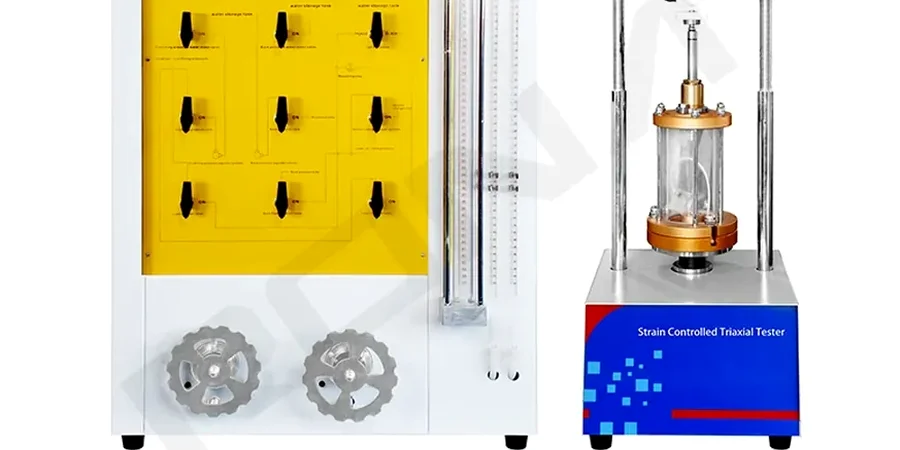
Local geotechnical conditions in Aurora
IBC Chapter 18 and ASCE 7-22 Section 12.13 require site-specific shear strength for any Aurora structure assigned Seismic Design Category C or higher. Glacial lacustrine clays in the Fox River valley can exhibit strain-softening behavior—peak strength drops significantly at displacements beyond 1 inch. If your foundation design uses peak phi from a single-stage direct shear test, you’re overestimating the safety margin. We’ve seen this in the dense residential subdivisions east of Route 59, where fill over natural clay created consolidation settlements that mobilized residual strength conditions. A drained triaxial test with post-peak measurement captures the strain-softening trend explicitly. The lab reports both peak and critical-state friction angles so the geotechnical engineer can decide which governs. For critical infrastructure—retaining walls along the riverbank, bridge abutments on I-88, or water treatment tanks—skipping triaxial testing isn’t a cost saving; it’s an invitation to a failure investigation.
Our services
Our Aurora lab runs the full triaxial suite—UU, CU, and CD—on both cohesive and cohesionless soils. Every test program starts with a review of your boring logs to select the right confining pressure range and saturation protocol.
CU Triaxial with Pore Pressure Measurement
Three-stage consolidated-undrained test with backpressure saturation and electronic pore pressure logging. Delivers effective stress parameters c’ and φ’ plus Skempton’s A coefficient at failure. Ideal for embankment stability and basement wall design in Aurora’s silty clays.
CD Triaxial for Drained Strength
Consolidated-drained test at slow shear rates per ASTM D7181. Measures volume change during shear to define dilatant or contractive behavior. Required for long-term slope analysis and for sands where drained conditions govern.
Quick answers
How much does a triaxial test program cost in Aurora?
What’s the difference between UU, CU, and CD triaxial tests?
UU (unconsolidated-undrained) gives total stress parameters—quick but doesn’t separate pore pressure effects. CU (consolidated-undrained) adds pore pressure measurement, yielding effective stress c’ and φ’. CD (consolidated-drained) allows full drainage during shear, measuring volume change and drained strength. For Aurora projects with long-term groundwater fluctuation, CU with effective stress interpretation is the most commonly specified option.
How many specimens do you need for a complete Mohr-Coulomb envelope?
Three specimens at different confining pressures is the minimum for a statistically valid envelope. We typically run confining stresses at 1x, 2x, and 3x the estimated in-situ effective vertical stress. For critical structures, a fourth specimen improves confidence in the cohesion intercept.
Can you test sand and gravel with a triaxial cell?
Yes, but sample preparation is different. Cohesionless soils require a split mold and vacuum to hold the specimen shape. For Aurora’s outwash sands, we prepare remolded specimens at the field density and moisture content you specify. Drained CD tests work best for sands because permeability allows pore pressure to dissipate.
What turnaround time should I expect for triaxial results?
A standard CU triaxial program with three specimens takes 10 to 14 business days from sample receipt to the final report. CD tests take longer—up to 18 business days—because the shear stage must run slowly enough to prevent pore pressure buildup.