Aurora’s glacial till and outwash deposits create a patchwork of subgrade conditions that can shift from stiff clay to silty sand within the same subdivision. The Fox River corridor adds seasonal groundwater that saturates base layers, and when freeze-thaw cycles hit the upper 42 inches—the typical frost depth for northern Illinois—weak subgrades lose bearing capacity fast. Highway engineers and commercial developers across the I-88 corridor depend on the [laboratory CBR test](/) to quantify soaked strength before committing to pavement thickness. Running the test per ASTM D1883 means compacting remolded specimens at target moisture and density, soaking them for 96 hours, and measuring penetration resistance with a standard 0.05 in/min piston. The result is a soaked CBR value that directly feeds into AASHTO 93 pavement design. For granular borrow and recycled concrete aggregate sources, we also run Proctor compaction on the same material to establish the moisture-density relationship that governs CBR specimen preparation.
A soaked CBR value is the single most influential number in AASHTO flexible pavement design—a shift of 3 points can change the required asphalt thickness by an inch.
Technical details of the service in Aurora
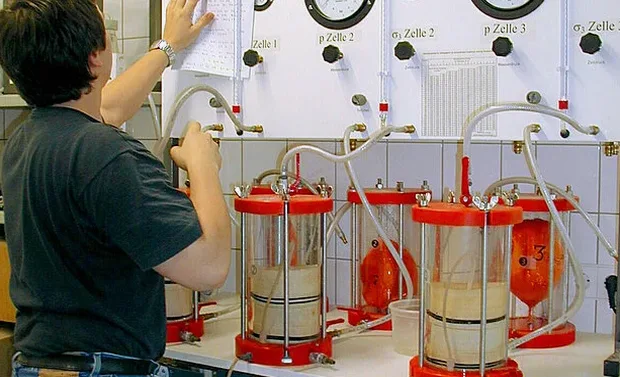
Local geotechnical conditions in Aurora
When a pavement design relies on a single CBR value taken from a borrow source that varies laterally, the risk of differential rutting is high. On Aurora’s east side, where glacial Lake Chicago deposited laminated silts and clays, subgrade stiffness can change within 100 feet. The soaked CBR test on a composite sample masks that variability unless the sampling plan is dense enough. We recommend running CBR on at least three specimens per distinct soil unit and pairing the data with grain-size distribution from ASTM D6913/D7928 to confirm material classification. For reconstructed arterials like Illinois Route 25 or New York Street, where traffic counts exceed 25,000 ADT, an under-designed subgrade leads to fatigue cracking that appears within the first five years. The Illinois Tollway’s pavement design manual pushes for soaked CBR values no lower than 6 for subgrade under flexible pavement, and if the lab reports 4 or below, stabilization or a thicker granular base becomes non-negotiable. Swell data from the 96-hour soak also warns the drainage designer whether edge drains and permeable base layers need to be oversized to handle perched water trapped above low-permeability subgrade.
Our services
Our Aurora geotechnical lab provides the full sequence of tests needed to move from soil classification to pavement section design. Each service below connects directly to the soaked CBR value that anchors the structural number calculation.
Soaked CBR with Compaction Curve Package
Complete ASTM D1883 CBR test on three remolded specimens compacted at optimum moisture content from a companion Proctor curve. Includes 96-hour soak under 10-lb surcharge, daily swell readings, penetration data at eight points, and corrected CBR values at 0.1 and 0.2 inches. Delivered as a signed report with load-penetration curves and swell-versus-time plots. Turnaround is five business days.
Subgrade Characterization Suite for Pavement Design
Combines laboratory CBR with grain-size analysis (ASTM D6913/D7928), Atterberg limits (ASTM D4318), and moisture content. Designed for projects that need AASHTO soil classification plus resilient modulus estimation from the CBR correlation (Mₗ = 1500 × CBR for fine-grained soils). Includes a summary table formatted for direct input into AASHTOWare Pavement ME Design software.
Frequently asked questions
How much does a laboratory CBR test cost for a project in Aurora?
For a single-point CBR test with a companion Proctor compaction curve, the cost ranges from US$120 to US$220 depending on the number of specimens and whether swell monitoring is required. A three-point CBR package, which provides the full CBR-versus-moisture relationship needed for mechanistic-empirical design, falls toward the upper end of that range. We provide a firm quote after reviewing the soil type and project specification requirements.
How long does the soaked CBR test take from sample delivery to report?
The full ASTM D1883 procedure requires five business days under standard scheduling. Compaction and specimen preparation take one day, the 96-hour soaking phase runs four days, and penetration testing plus report preparation occupies the fifth day. Expedited two-day turnaround is available for emergency pavement investigations, but the soak period cannot be shortened without deviating from the standard.
What is the difference between field CBR and laboratory soaked CBR, and which one should I use for pavement design?
Field CBR tests using a Dynamic Cone Penetrometer give an instant unsoaked value at in-situ moisture, which is useful for construction verification but not for design. The laboratory soaked CBR per ASTM D1883 represents the worst-case saturated subgrade condition that pavement will experience over its service life in Aurora’s climate. The Illinois Department of Transportation and the AASHTO 93 design guide both require the soaked laboratory value for structural number calculations, because it accounts for seasonal groundwater rise and freeze-thaw weakening that field tests miss.