In Aurora, where the Pierre Shale and Denver Basin claystone weather into highly expansive soils, a conventional spread footing is often a gamble. That’s why the Deep Excavations team on our side coordinates closely with the foundation designers from the start. The 2024 International Building Code (IBC) and Chapter 18 of ASCE 7-22 require that mat foundations on these soils account for swelling pressures that can easily exceed 15,000 psf. Our approach moves beyond simple bearing capacity checks. We model the stiffness interaction between the structural slab and the underlying ground, factoring in moisture variation zones that in Aurora extend from the surface down to 15 or 20 feet depending on the season and irrigation patterns. A raft foundation here must distribute loads broadly enough to prevent edges from curling upward during dry winters and settling during summer monsoons—a dual-phase movement that we have documented in neighborhoods from Murphy Creek to Aurora Highlands.
A mat foundation in Aurora isn't just a thick slab; it's a structural element that must ride seasonal heave cycles in the Denver Basin without transmitting differential movement to the frame above.
Technical details of the service in Aurora
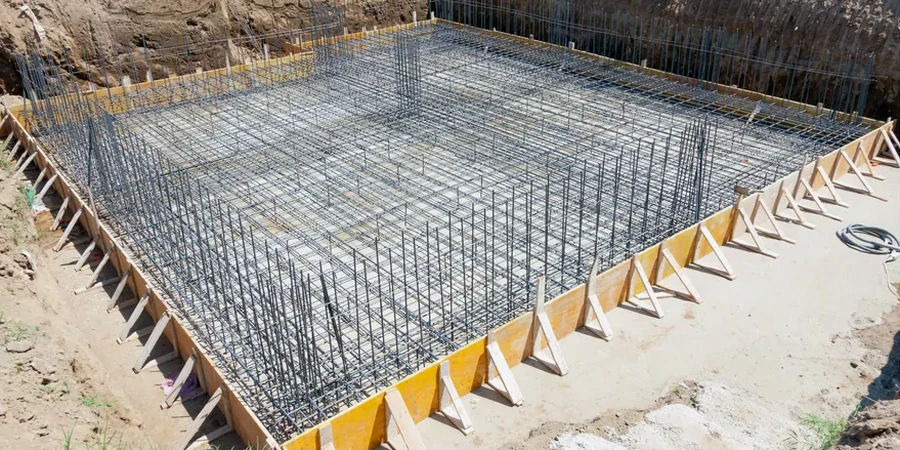
Local geotechnical conditions in Aurora
The most common—and costly—mistake we see in Aurora is when a contractor assumes that a 12-inch uniform mat with #4 bars at 18 inches on center will perform adequately on untreated expansive clay. Within three to five years, the edges heave, interior partition walls crack, and plumbing rough-ins shear right at the slab penetration. The error isn't just undersizing the reinforcement; it's failing to commission a site-specific swell test and then designing the mat with a generic k-value pulled from a textbook. We have walked onto jobsites near the Aurora Reservoir where the owner had already poured the mud slab before anyone checked whether the subgrade was compacted fill over a former drainage swale. At that point, remediation meant partial demolition and installing a void form system beneath the mat—an expense that dwarfed the cost of the original geotechnical investigation. When the design incorporates deep stiffening beams and a properly compacted select fill layer, the mat behaves monolithically and the structure stays serviceable through multiple wet-dry cycles.
Our services
Our Aurora office delivers a complete package that starts with the subsurface investigation and carries through to the final mat design and construction-phase observation. Every project gets a dedicated geotechnical engineer who understands Front Range geology and the local permitting process.
Subsurface Investigation for Mat Design
We deploy mechanical borings with Shelby tube sampling and MASW geophysics to map soil variability across the mat footprint. Atterberg limits, percent swell, and consolidation parameters feed directly into the finite element model.
Soil-Structure Interaction Modeling
Using the modulus of subgrade reaction and swell pressure data from your site, we build a Winkler-spring or continuum model that predicts deflection, moment, and shear distribution under both gravity and swell-induced loading.
Post-Tensioned Mat Design
We size the slab thickness, tendon layout, and stiffening beams per PTI DC10.5-21, accounting for the center-lift and edge-lift conditions typical of Aurora's expansive clay. Deliverables include signed and sealed construction drawings.
Construction QA/QC and Proof Testing
During construction, we verify subgrade preparation, moisture conditioning, fill compaction with Proctor Tests, and concrete placement. Post-tensioning stressing records are reviewed against design elongations.
Quick answers
What makes a mat foundation different from a thickened-edge slab in Aurora's soils?
A true mat foundation distributes the entire building load across a continuous reinforced slab, often with interior stiffening beams, while a thickened-edge slab only reinforces the perimeter. On Aurora's expansive clay, a mat with a properly designed void form system or carton forms isolates the slab from swelling pressures, whereas a simple thickened-edge slab can still experience differential heave that damages the structure.
How deep do you need to drill to design a mat foundation in Aurora?
Our borings typically extend to 25 or 30 feet below the proposed mat bottom, penetrating through the active moisture fluctuation zone and into the more stable claystone. This depth lets us characterize both the seasonal swell potential and the deeper bearing stratum—critical when the mat must bridge over localized soft zones common in the Denver Basin.
What is the typical cost range for a mat foundation design in Aurora?
Does the City of Aurora require a specific type of mat foundation report for permitting?
Yes—the City of Aurora building department requires a geotechnical report stamped by a Colorado-licensed professional engineer that includes design recommendations for the mat foundation, allowable bearing pressures, swell potential classification, and specifications for subgrade preparation. Our reports follow the city's current submittal checklist and have a strong track record with plan reviewers.