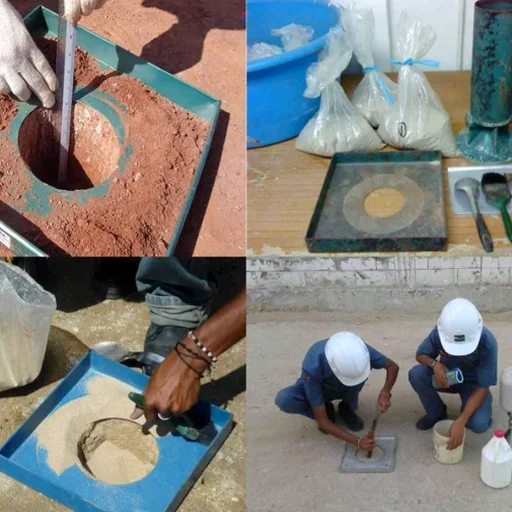
The 2018 International Building Code, as adopted by the City of Aurora, requires compaction verification on structural fill, utility backfill, and pavement subgrades before placing foundations or asphalt. On the silty clay loams that dominate the Fox River Valley, achieving 95% of modified Proctor density is not a given—it takes methodical lift placement and moisture conditioning. Our team runs ASTM D1556 sand cone tests across Kane and DuPage County job sites, delivering density readings that hold up under the scrutiny of Aurora’s building inspectors. When trench backfill passes on the first test, the pipe crew stays on schedule. Proctor tests establish the reference curve in our AASHTO-accredited lab before field work begins, so every sand cone result ties directly to a project-specific maximum dry density.
A sand cone test gives you density and moisture in 20 minutes—no radioactive source, no calibration drift, just a hole, sand, and a scale.
Technical details of the service in Aurora
Local geotechnical conditions in Aurora
A tilt-up warehouse off I-88 in Aurora had foundation subgrade prepared in November, passed density tests, then sat exposed through a wet spring. By the time the slab crew arrived, the upper 12 inches had softened to 82% compaction. Silty soils in the Aurora area are particularly sensitive to moisture changes; a few freeze-thaw cycles can destroy compaction in the upper lifts. Re-testing before critical placements is not optional. On utility trenches, we have seen settlement of 4 to 6 inches within the first year when backfill density was not verified at each lift. The sand cone test is the direct evidence that the spec was met—and it is the only density test method explicitly referenced in Aurora’s public works standards for trench backfill acceptance.
Our services
Our field density services in Aurora cover the full compaction verification workflow, from lab Proctor to final report. Each service runs under our AASHTO Materials Reference Laboratory (AMRL) accredited quality system.
Sand Cone Density Testing
ASTM D1556 field density on structural fill, utility backfill, and pavement subgrade. Includes wet density, dry density, moisture content, and percent compaction calculation. Results delivered same day.
Modified Proctor (ASTM D1557)
Laboratory compaction curve using the 56,000 ft-lbf/ft³ effort. Establishes the maximum dry density and optimum moisture content for your specific fill material before field testing begins.
Compaction Verification Package
Combined lab Proctor plus scheduled field sand cone testing with GPS-tagged locations, photo documentation, and a signed summary report for the building department.
Quick answers
How much does a sand cone density test cost in Aurora?
How deep does the sand cone test measure?
The standard sand cone test per ASTM D1556 measures the density of a single compacted lift, typically 4 to 6 inches deep. The test hole is excavated to the full depth of the lift. If you need density verification deeper than 6 inches, we run multiple tests at successive lifts or combine sand cone testing with SPT drilling to assess deeper fill compaction.
Does Aurora building department accept sand cone results?
Yes. The City of Aurora Building and Permits Division accepts ASTM D1556 sand cone test reports for compaction verification as part of the foundation inspection package. We provide signed, dated reports with test location maps that meet the special inspection requirements under IBC Chapter 17. For public works projects, the method is explicitly referenced in the city’s standard specifications for trench backfill.
How quickly can I get test results on site?
Wet density and moisture content are calculated on site within about 20 minutes of completing the test. The technician can give the superintendent a verbal pass/fail immediately. The formal PDF report with percent compaction, test coordinates, and photo documentation is emailed the same day, usually within four hours of completing the field work.