Aurora's expansion along the Fox River has pushed development onto alluvial deposits and outwash plains where loose sands and silty sands often control the foundation design. We see this pattern repeatedly in projects near the I-88 corridor and the former industrial zones south of downtown. When SPT blow counts drop below 10 in the upper 20 feet, bearing capacity alone is not the only problem—differential settlement and liquefaction potential drive the need for ground improvement. Vibrocompaction design addresses these conditions by specifying probe spacing, energy input, and verification testing that match the grain-size distribution of the site. For sites where fines content exceeds 15 percent, we often pair the densification plan with a CPT evaluation to confirm that the soil fabric will respond to vibratory treatment before mobilizing equipment.
A well-designed vibrocompaction grid in clean Fox Valley sands can increase relative density from 40 percent to over 75 percent, eliminating the need for deep foundations on many mid-rise structures.
Technical details of the service in Aurora
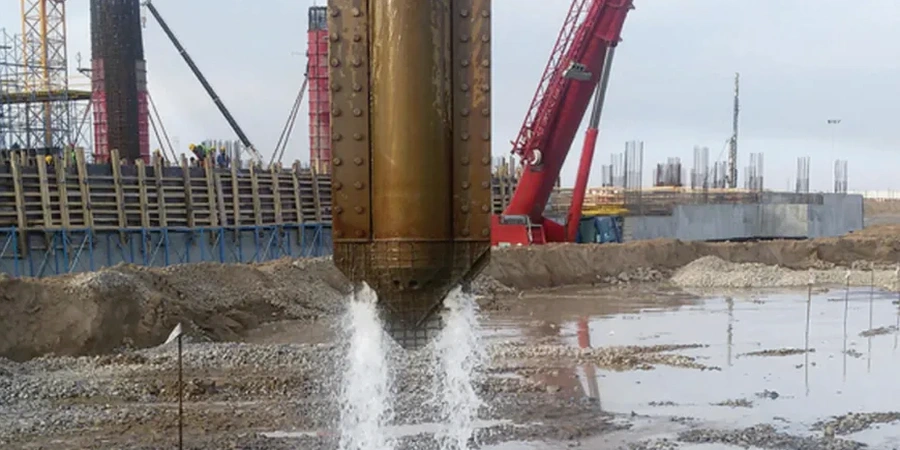
Local geotechnical conditions in Aurora
A warehouse project near Orchard Road taught us a hard lesson about skipping pre-treatment grain-size analysis. The site log showed clean sand to 35 feet, so the contractor assumed vibrocompaction would work. After three weeks of treatment, CPT readings barely moved—the sand contained 18 percent non-plastic silt, enough to dampen the vibratory energy and prevent particle rearrangement. The owner lost six weeks and had to switch to stone columns at significant cost. In Aurora's glacial stratigraphy, thin silt seams within the sand matrix are common and cannot be detected by SPT alone. We now require wash-sieve analysis at 5-foot intervals before finalizing a vibrocompaction design. Another risk is undercompaction below the water table; if the probe extraction rate exceeds 1 foot per second, the sand collapses before densification takes hold. Our designs specify hold times and amperage thresholds tied directly to the CPT tip resistance target.
Our services
Our vibrocompaction design package covers the full workflow from feasibility assessment through post-treatment signoff. Every project in Aurora includes a desktop review of county well logs and surficial geology maps before we mobilize for site investigation.
Feasibility and Grain-Size Screening
Wash-sieve analysis at multiple depths to confirm fines content below the threshold for effective vibrocompaction. We correlate grain-size curves with published case histories to predict densification response.
Grid Design and Energy Specification
Triangular or square pattern layout with probe spacing, amperage targets, and hold-time criteria. Designs include liquefaction trigger analysis under ASCE 7-22 for the Aurora seismic design category.
Post-Treatment Verification Testing
CPT soundings at centroid and edge locations, plus shear-wave velocity profiles where NEHRP site class improvement is required. We deliver a stamped report with before-and-after comparisons.
Frequently asked questions
How much does vibrocompaction design cost for a typical Aurora commercial lot?
Design fees for vibrocompaction on a standard 2- to 5-acre commercial parcel in Aurora generally range from US$1,570 to US$4,870, depending on the number of treatment zones, depth of densification, and the verification testing protocol required by the geotechnical engineer of record.
Can vibrocompaction work in the silty sands found near the Fox River?
It depends on the silt content. Clean Fox River sands with less than 12 percent fines densify very well with vibrocompaction. Sands with 15 to 20 percent non-plastic silt may require higher energy input and closer probe spacing, and anything above 20 percent fines usually calls for an alternative method like stone columns or compaction grouting.
How do you verify that the ground improvement actually worked?
We run CPT soundings at the center of each treatment cell and at cell boundaries, typically 7 to 14 days after compaction. The tip resistance and sleeve friction are compared directly to pre-treatment baselines. For projects requiring a site class upgrade, we also run MASW lines to document the shear-wave velocity increase.
What depth of loose sand can vibrocompaction treat effectively?
Standard rigs handle 50 to 65 feet easily; with extension leaders we can reach 100 feet. In Aurora's geology, most loose zones are in the upper 30 to 45 feet within the Henry Formation outwash, so depth is rarely a limiting factor for mid-rise commercial buildings.