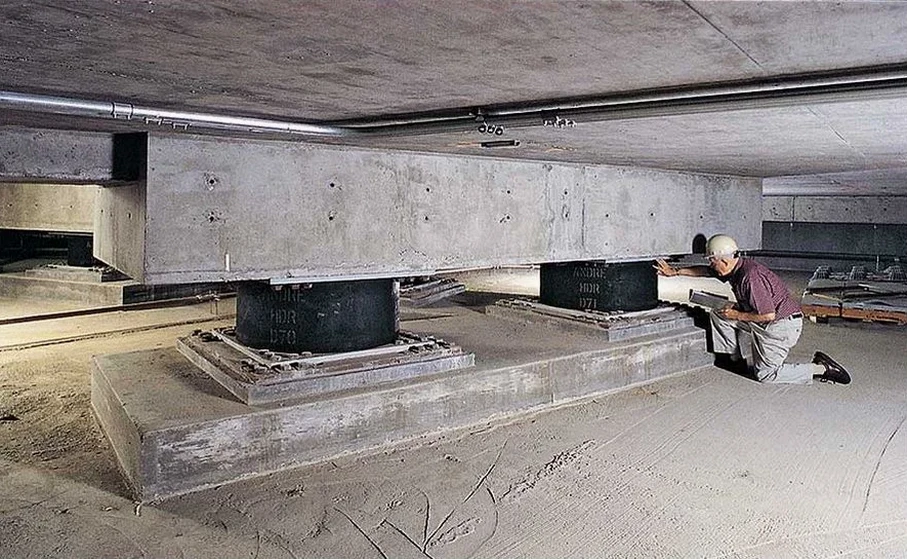
A nine-story medical office building near the Anschutz Medical Campus sat on a site with interbedded stiff clays and loose sands typical of the Denver Basin. The project seismic hazard analysis showed a design spectral acceleration SDS of 0.42g at the short period, but the site class D amplification pushed the MCE-level demands well beyond what a fixed-base concrete shear wall could handle without significant drift. We integrated a base isolation seismic design approach using high-damping lead rubber bearings placed between the foundation mat and the ground-level podium slab, which shifted the fundamental period past 3.0 seconds and cut the superstructure forces by over 60 percent. Before detailing the isolation plane, we ran a MASW survey to confirm the VS30 profile to 30 meters depth, because the ASCE 7-22 site classification directly controls the isolator displacement demand and the moat wall clearance.
A properly tuned base isolation system in Aurora shifts the effective period past 3 seconds, cutting base shear by 60 to 70 percent compared to a fixed-base design on site class D soils.
Technical details of the service in Aurora
Local geotechnical conditions in Aurora
Aurora sits on the western edge of the Denver Basin, where the subsurface transitions from granular Cherry Creek alluvium in the floodplain to stiff, overconsolidated Pierre Shale on the uplands. This lateral variability means two buildings 500 meters apart can have site class C and site class E profiles, with a 40 percent difference in the MCE spectral ordinates. If the isolation system is designed using a generic site class assumption instead of borehole-specific VS30 data, the isolator displacement demand gets underestimated and the moat wall clearance becomes insufficient for the actual ground motion. The deep soil column in the basin also generates significant basin-edge effects at periods above 2 seconds, which falls right in the isolation period range and can amplify the isolator stroke beyond the code-minimum estimate. We address this by running site-specific response spectra from seismic microzonation studies and ground motion records scaled to the Aurora target spectrum, then performing nonlinear time-history analysis with seven spectrally matched accelerogram pairs per ASCE 7-22 §17.5.4.
Our services
The base isolation scope spans from the geotechnical characterization of the bearing stratum to the nonlinear structural analysis and the construction-phase oversight of isolator installation. Every project in Aurora gets a soil-structure interaction model calibrated to the specific stratigraphy encountered at the borings.
Isolation System Design and Nonlinear Analysis
Selection and modeling of LRB, friction pendulum, or hybrid isolation systems with nonlinear time-history analysis using spectrally matched ground motion suites. We deliver the isolation plane geometry, isolator schedule with stiffness and damping properties, moat wall detailing, and utility crossing flex loops. The analysis package includes the ASCE 7-22 required upper-bound and lower-bound isolator property sensitivity cases and the wind restraint verification per §17.2.5.2.
Geotechnical Integration and Substructure Design
Characterization of the bearing stratum stiffness and damping for the soil spring model beneath isolator pedestals. Includes crosshole or downhole seismic testing to measure VS and VP profiles, cyclic triaxial testing for modulus reduction curves, and the design of the mat foundation or pile cap system that transfers isolator loads to the ground. For Aurora sites with Pierre Shale, we include the swell pressure analysis and the isolation plane detailing that accommodates differential heave.
Quick answers
What does base isolation seismic design cost for a mid-rise building in Aurora?
How does the Denver Basin site class affect isolator displacement demand?
The deep sedimentary column of the Denver Basin amplifies long-period ground motion, which directly increases the spectral displacement demand on the isolation system. Site class D profiles in Aurora typically produce MCE isolator displacements 20 to 30 percent larger than site class C profiles for the same structure, because the softer soil column shifts energy into the 2-to-4-second period band where the isolated structure resonates. We always run site-specific response spectra rather than relying on the ASCE 7 generic site coefficients.
Can base isolation be retrofitted to an existing building in Aurora?
Yes, although it requires a phased construction approach that is more involved than new-build isolation. The existing columns are temporarily supported with jacking systems, the column base is cut, and isolators are inserted between the column and the foundation. For Aurora buildings on shallow spread footings, we often need to enlarge or underpin the foundation elements to distribute the isolator point loads. A detailed structural survey and geotechnical reassessment are the first steps.
What isolator types are best suited for the Aurora seismic environment?
Lead rubber bearings (LRB) and friction pendulum bearings (FPB) both perform well in Aurora's seismic hazard environment. LRBs provide inherent damping and a well-characterized bilinear hysteresis loop, which works well for the moderate PGA levels and longer return periods typical of the Denver Basin. FPBs offer higher displacement capacity and self-centering behavior, which is advantageous for sites near the Cherry Creek floodplain where differential settlement tolerance is needed. The choice depends on the specific spectral shape and the building's service-level wind restraint requirements.